Published 28 July 2026
|
14-minute read
|
Tottington Manor Weddings Team
Should your wedding guests stay overnight? For some celebrations, accommodation is simply a useful extra. For others, it changes the entire rhythm of the wedding: guests arrive with less stress, stay later, travel more safely and gather again over breakfast the following morning.
The real question is not whether every guest should stay
The useful question is: which guests would have a noticeably better experience if they stayed overnight? A couple with forty mostly local guests may need only a handful of rooms. A wedding of the same size involving two families travelling from opposite ends of the country may need accommodation for almost everybody.
On-site rooms are most valuable when they remove friction. They can prevent an elderly relative facing a difficult late journey, allow parents with a young child to settle them nearby, give the wedding party somewhere dependable to prepare, and let guests enjoy the evening without repeatedly checking taxi apps or appointing a reluctant driver.
Image required: wedding-guests-arriving-with-luggage.jpg — a natural photograph of guests arriving at Tottington Manor with small overnight bags.
Why weddings with accommodation often feel more relaxed
A wedding day already contains a surprising number of transitions: travel, check-in, ceremony, drinks, photographs, dinner, speeches, dancing and departure. Accommodation at or very close to the venue removes one of the most disruptive transitions — leaving the celebration and travelling somewhere else late at night.
Hitched highlights the pleasure of keeping family and friends together and sharing breakfast the following day, while Guides for Brides describes accommodation as a way to make the celebration more sociable and seamless. Those are fair descriptions, but the benefit is not merely convenience. Guests who know their room is a short walk away are often more present. They are less likely to leave immediately after the first dance, more likely to relax over dinner and less preoccupied with the journey home.
The best accommodation plan is not the one with the most bedrooms. It is the one that removes the most stress for the people who matter.
Which guests should be offered rooms first?
1. The couple and the wedding party
The newlyweds need privacy at the end of the evening, but the wedding party may also need rooms for practical reasons. Bridesmaids, groomsmen and close family are commonly involved from early morning until late at night. Staying at the venue can simplify preparation, clothing, flowers, gifts and the inevitable collection of belongings afterwards.
2. Parents and close family
Parents are often among the first to arrive and last to finish. A room nearby means they can step away briefly, change clothing, store important items and return to the celebration without a separate journey.
3. Older relatives and guests with mobility needs
These guests may value proximity more than luxury. When viewing a venue, ask where accessible rooms are positioned, whether there are steps, how far the bedrooms are from the reception space and what help is available with luggage.
4. Families with babies or young children
An on-site bedroom can make the difference between parents leaving after dinner and remaining part of the celebration. It creates a nearby base for feeding, changing, quiet time or a trusted babysitting arrangement. Couples should never assume every parent wants to stay, but giving them the option is thoughtful.
5. Guests travelling a significant distance
Someone travelling from London, the Midlands or overseas may already have invested considerable time in attending. Clear accommodation information removes another layer of research and helps them plan trains, flights, taxis and annual leave.
6. Anyone who would otherwise face a difficult late-night journey
Country wedding venues can be wonderfully peaceful and wonderfully inconvenient for spontaneous taxis. Guides for Brides advises considering accommodation and transport early, particularly for rural venues and late finishes. That is sound advice: pre-arranged transport is usually calmer and more dependable than trying to find several vehicles at midnight.
Do the couple have to pay for guest rooms?
In the UK, guests will commonly expect to pay for their own accommodation. The couple's responsibility is generally to provide clear, timely information rather than to fund every stay. Exceptions are personal rather than compulsory. A couple might pay for parents, a grandparent, members of the wedding party, a carer or a guest who could not otherwise attend.
Before promising rooms, establish exactly how the venue handles them. Ask whether rooms are optional, held provisionally, included within a package or subject to a minimum commitment. Some venues require a set number of rooms to be taken; others allow guests to book directly. The financial difference can be substantial, so this belongs in the venue comparison rather than being discovered after the contract is signed.
Questions to ask about wedding accommodation
How many bedrooms are available on the wedding night?
Are they reserved exclusively for wedding guests?
Who pays, and when is payment due?
Is there a minimum room commitment?
What are check-in and check-out times?
Can anyone prepare in a bedroom before normal check-in?
Is breakfast included?
Which rooms are accessible or suitable for families?
What nearby accommodation and transport can be recommended?
How many rooms should you reserve?
Begin with names, not percentages. Mark the guests who are definitely likely to stay, those who might stay and those who are almost certainly travelling home. Then group couples and families sensibly to estimate rooms rather than people.
The Knot's guidance on room blocks recommends considering the guest list, travel and surrounding wedding-weekend events before deciding how many nights or rooms may be needed. For a small British hotel or country venue, the process may be more personal than a formal room block, but the principle is the same: avoid committing to more rooms than guests are realistically likely to use.
Send an early accommodation question before making a large financial commitment. It can be as simple as: “We are considering reserving bedrooms at the venue. Would you be likely to stay on Friday, Saturday, both nights or neither?” This is not a booking, but it provides far better evidence than guessing.
What happens when there are not enough bedrooms?
Limited accommodation is not necessarily a disadvantage. A boutique venue may create a closer atmosphere because the rooms are allocated to the people most involved in the celebration. The important part is managing overflow well.
Provide guests with two or three nearby options at different price points, approximate travel times, booking details and a transport plan. Avoid publishing a sprawling list of every property in the county. A short, checked list is more useful. Confirm that suggested accommodation is still operating and make clear that availability and prices can change.
Image required: wedding-bedroom-allocation-plan.jpg — room keys, a guest list and handwritten bedroom allocations.
Should guests stay the night before as well?
That depends on the distance travelled and the shape of the celebration. Staying the night before can be valuable for the wedding party, parents and anyone with an early role. It reduces the risk of traffic or train disruption affecting preparation and can support a relaxed family dinner or welcome drink.
It can also create complications if too many people expect access to the couple on the evening before the wedding. Protect some private time. A small dinner with clear finishing time may be more restful than accidentally hosting a second wedding reception before the first one has begun.
Breakfast is part of the guest experience
The morning after is often the first opportunity to speak properly to people who were divided between tables, photographs and the dancefloor. A good breakfast does not need to become another formal event. It simply provides a gentle ending: coffee, stories from the night before, exchanging photographs and saying goodbye without coats being collected in a midnight rush.
Ask what time breakfast is served, whether all resident guests dine together and whether non-residents can join by arrangement. The answers affect whether the next morning feels like part of the wedding or merely hotel checkout.
Accommodation and intimate weddings
Accommodation can have an even greater effect on a wedding of around thirty guests. When much of the guest list stays together, the celebration begins to resemble a private house party with hotel service: people meet over breakfast, gather naturally in the bar and spend more time together than they would at a larger event.
This does not mean every intimate wedding needs exclusive use or that every guest must stay. It means bedrooms can deepen the experience when closeness and unhurried time are central to the reason for choosing a smaller wedding.
A Tottington Manor example
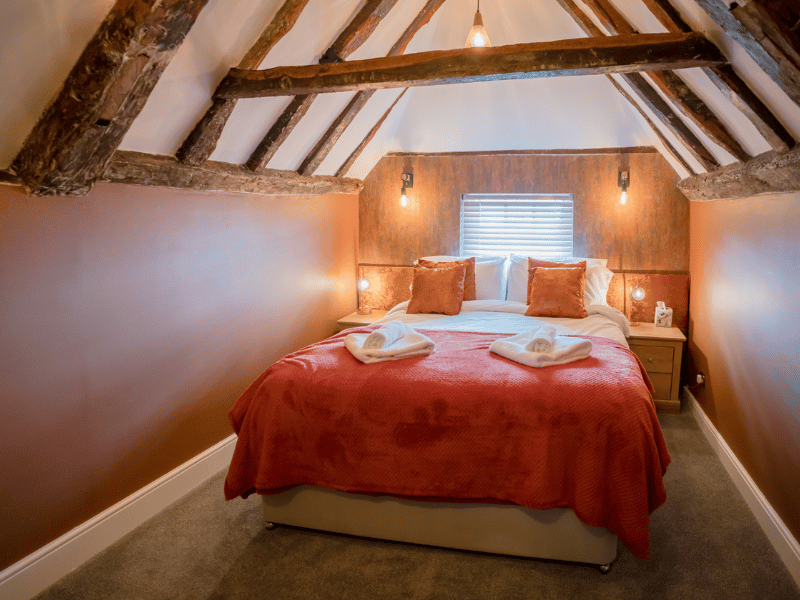
Tottington Manor has twelve individually styled bedrooms. At a wedding, the honeymoon room is reserved for the couple and the remaining rooms can be made available for wedding guests, subject to the arrangements confirmed for that date. This suits couples who want their closest family and friends nearby without turning bedroom allocation into a requirement for the entire guest list.
The practical advantage is that the ceremony, wedding breakfast, evening party and overnight stay can happen within one setting. Guests who cannot stay at the hotel can be given nearby accommodation and transport information. The combination works particularly well for celebrations where the couple wants the atmosphere of a country wedding without repeatedly moving guests between separate locations.
Our recommendation
Do not choose a wedding venue with accommodation simply because bedrooms look attractive in photographs. Choose it because you understand how those rooms will improve the day for real people. Identify who needs them, establish the costs and terms, make an overflow plan and communicate everything early.
When that work is done properly, staying overnight becomes much more than somewhere to sleep. It allows the wedding to end gradually rather than abruptly — and sometimes the conversations over breakfast become as memorable as the formal moments the day before.
Frequently asked questions
Usually guests pay for their own rooms. Couples may choose to pay for close family, the wedding party or a guest whose attendance would otherwise be difficult.
Send them as early as practical, particularly for popular dates or rural areas. Guests travelling a long distance often want to arrange accommodation soon after receiving the date.
Prioritise the couple, wedding party, close family and guests with the greatest practical need, then provide a checked list of nearby options and planned transport.
Planning a Wedding in Sussex?
Tottington Manor is an independent country hotel and wedding venue in the South Downs near Henfield, West Sussex. Couples can hold their ceremony, wedding breakfast, evening celebration and overnight stay in one relaxed setting, supported by an experienced in-house weddings team.
Discover Tottington Manor's wedding spaces, dining, gardens and twelve boutique bedrooms, then download the wedding brochure to begin planning your celebration.
Gift your friends or family a Tottington Experience with our gift vouchers, whether it be for an Afternoon Tea, Dining or Overnight Stay. Our vouchers can be bought in person from the hotel or online and emailed as a PDF or posted to you.